Day: January 2, 2026

  • Is It ADHD or Trauma? How to Tell the Difference (And Why It Matters)

    Is It ADHD or Trauma? How to Tell the Difference (And Why It Matters)

    Many adults—especially women—come to me with the same quiet question:

    “Is this really ADHD… or is it trauma?”

    They’re not asking out of curiosity.
    They’re asking because they’ve tried productivity systems, medication, therapy, self-help—and still feel stuck, overwhelmed, or chronically dysregulated.

    This question matters because ADHD and trauma can look strikingly similar on the surface, yet require very different kinds of support. And when we miss that distinction—or assume it has to be either/or—people often end up feeling worse, not better.

    Let’s slow this down and look at what’s actually happening.

    ADHD and Trauma: Why the Confusion Is So Common

    ADHD is a neurodevelopmental condition that affects attention regulation, impulse control, working memory, and executive functioning.

    Trauma, particularly chronic or developmental trauma, shapes the nervous system around safety and survival.

    From the outside, both can present as:

    • Difficulty focusing
    • Disorganization and task paralysis
    • Emotional reactivity
    • Restlessness or shutdown
    • Trouble following through

    But the why underneath these behaviors is not the same.

    That’s where things get missed.

    Where ADHD and Trauma Overlap

    ADHD and trauma often overlap in symptoms because both affect how the brain and nervous system process information.

    Here’s a simplified way to think about it:

    • ADHD struggles often stem from difficulty regulating attention and effort
    • Trauma struggles often stem from difficulty regulating safety and arousal

    When the nervous system doesn’t feel safe, focus naturally becomes harder.
    When attention regulation is already challenging, stress hits harder.

    This overlap is why misdiagnosis is common—and why many adults feel confused after receiving an ADHD diagnosis that doesn’t fully explain their experience.

    Venn Diagram: Shared vs. Distinct Symptoms

    The following Venn diagram illustrates the overlap and differences between ADHD and trauma-related symptoms.
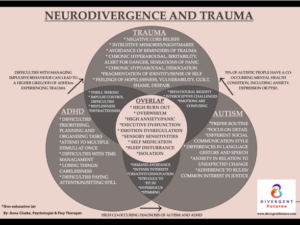
    Venn Diagram of Neurodivergence and Trauma from Dr. Anna Clark of Divergent Futures

    Shared symptoms may include:

    • Inattention or “spacing out”
    • Emotional overwhelm
    • Difficulty with organization and planning
    • Restlessness or agitation

    More typical of trauma (not ADHD alone):

    • Hypervigilance
    • Intrusive thoughts or memories
    • Avoidance behaviors
    • Physiological stress symptoms (racing heart, nausea, muscle tension)
    • Dissociation or emotional numbing

    More typical of ADHD (not trauma alone):

    • Chronic time blindness
    • Excessive talking or interrupting
    • Difficulty sustaining effort even in safe, calm environments
    • Lifelong patterns present across many contexts

    Venn diagram adapted from training materials by Anna Clarke, used here with attribution and permission.

    One of the Most Important Questions to Ask

    Instead of asking:
    “What’s wrong with me?”

    A more useful question is:
    “Did these symptoms exist before stress and adversity—or did they intensify after?”

    Here’s a general guideline clinicians use:

    • ADHD symptoms tend to be consistent across environments and present early in life (diagnostically prior to age 12)
    • Trauma-related symptoms often fluctuate with safety, stress, and relational context

    This doesn’t mean it’s one or the other.

    Many people—especially women with late diagnoses—have both ADHD and trauma, and the interaction between them can amplify symptoms in powerful ways.

    Why “Safety First” Matters

    One of the biggest mistakes I see is trying to treat attention challenges without first addressing nervous system regulation.

    When someone’s system is in fight, flight, freeze, or shutdown:

    • Focus tools don’t stick
    • Productivity strategies feel impossible
    • Medication alone may increase anxiety or agitation

    This doesn’t mean ADHD medication is wrong.
    It means regulation must come first.

    A nervous system that doesn’t feel safe cannot sustain attention—no matter how motivated or capable someone is.

    So… Is It ADHD, Trauma, or Both?

    Often, the answer is both/and.

    ADHD can increase vulnerability to trauma.
    Trauma can intensify ADHD traits.
    And chronic masking can blur the lines even further.

    That’s why accurate assessment, nervous system awareness, and compassionate pacing matter so much—especially for high-functioning women who have spent years pushing through.

    Want to Go Deeper?

    If this topic resonates, I’ve explored it more fully in these two YouTube videos:

    Is It ADHD or Trauma? Find Out Now!
    The Hidden Trauma Behind ADHD

    Both break this down in an accessible, nervous-system-informed way and may help you notice patterns you hadn’t seen before.

    A Gentle Next Step

    If you’re realizing that willpower, pressure, and “trying harder” haven’t worked—and you’re craving a more compassionate, body-aware approach—

    The Self-Loved ADHD Woman Way: How to Stop Playing Small with ADHD is a guided journal-book experience designed to help you slow down, regulate your nervous system, and reconnect with yourself without fixing or forcing.

    It’s not about labels.
    It’s about learning how your system works—and meeting it with care.

    You can learn more here:
    👉 https://jenbarnes.org/stop-playing-small/
  • Stop Masking ADHD: Why High-Achieving Women Burn Out (and What’s Underneath)

    Stop Masking ADHD: Why High-Achieving Women Burn Out (and What’s Underneath)

    If you’re a woman with ADHD who looks confident, capable, and “put together” on the outside — but feels exhausted, anxious, or disconnected on the inside — masking may be playing a bigger role than you realize.

    Many high-achieving ADHD women don’t struggle because they lack skills or motivation. They struggle because they learned, very early on, how to hide parts of themselves in order to stay safe, accepted, and successful.

    This post isn’t about telling you to “just unmask” or “be yourself.”
    It’s about understanding why masking worked, what it costs, and what actually creates true confidence from within.

    What ADHD Masking Really Is (and Why Women Learn It Early)

    ADHD masking is the process of suppressing, compensating for, or hiding ADHD traits in order to meet external expectations.

    For many women, masking starts in childhood.

    Girls are often rewarded for being:
    quiet
    helpful
    emotionally aware
    responsible
    easy to manage

    So when ADHD shows up — through distraction, emotional intensity, restlessness, or inconsistency — many girls learn to adapt, not disrupt.

    They don’t get labeled as “a problem.”
    They get labeled as “mature,” “sensitive,” or “hard on themselves.”

    Masking becomes a survival strategy — not a flaw.

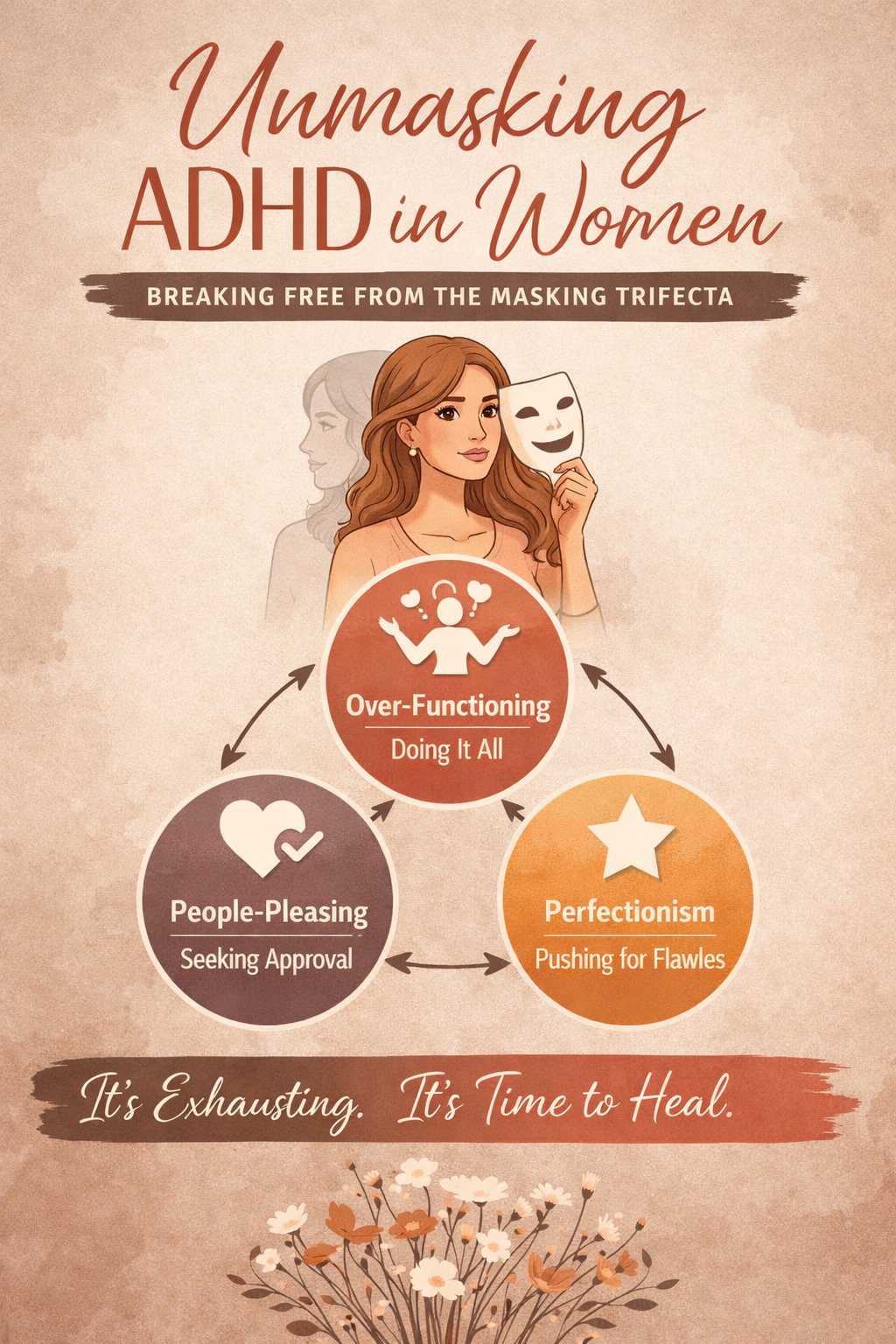
    The Masking Trifecta Many High-Achieving Women Develop

    Over time, masking often consolidates into a powerful pattern I see again and again in high-achieving ADHD women.

    It usually shows up as a trifecta:

    Over-functioning
    Doing more than your share. Carrying responsibility others don’t see. Holding everything together so nothing falls apart.

    People-pleasing
    Tracking others’ emotions. Anticipating needs. Avoiding conflict. Saying yes when your body wants to say no.

    Perfectionism
    Trying to get it “right” so you won’t be criticized, misunderstood, or seen as unreliable. Mistakes feel dangerous, not neutral.

    These aren’t personality flaws.
    They are adaptive strategies that once helped you belong, succeed, or stay emotionally safe.

    And for a while, they work.

    Until they don’t.

    Why Masking Is So Exhausting (A Nervous System Lens)

    Masking takes energy. A lot of it.

    From a nervous system perspective, masking keeps you in a state of constant self-monitoring:
    How am I coming across?
    Am I doing this right?
    Am I too much? Not enough?

    That vigilance taxes your system.

    Over time, many women experience:
    chronic fatigue
    anxiety or depression
    burnout
    loss of self-trust
    difficulty accessing joy or creativity

    Not because they’re weak — but because they’ve been living in performance mode instead of safety.

    True regulation doesn’t come from holding yourself together harder.
    It comes from feeling internally supported.

    Masking Isn’t the Opposite of Confidence — It’s Often Mistaken For It

    Here’s one of the most important distinctions I want to make:

    Masking can look like confidence.
    But it isn’t the same thing.

    Confidence rooted in masking depends on:
    approval
    performance
    external validation
    never dropping the ball

    Confidence rooted in internal safety looks different.

    It shows up as:
    self-trust
    flexibility
    boundaries
    choice

    This is why many women who “have it all together” feel the least confident inside. Their confidence has been outsourced.

    Is Unmasking Always the Goal?

    No.

    Unmasking isn’t something you owe anyone.
    And it’s not always safe or appropriate to do everywhere.

    What is essential is having choice.

    When masking becomes automatic — when you don’t even know you’re doing it — it can quietly erode your well-being. Too much masking, for too long, often leads to inner distress… and eventually illness.

    The goal isn’t to rip the mask off.
    The goal is to build enough internal safety that you don’t need it all the time.

    What Actually Replaces Masking

    What replaces masking isn’t exposure or over-sharing.

    It’s:
    understanding your nervous system
    learning when you’re over-functioning instead of choosing
    recognizing people-pleasing as protection, not identity
    letting go of perfectionism as safety

    And slowly rebuilding confidence from the inside out.

    This is the work of self-trust — not self-correction.

    Want to Understand Masking More Deeply?

    If this resonated — if you recognized yourself in the masking, the over-functioning, or the quiet exhaustion — I explore this more deeply in my YouTube video:

    Stop Masking ADHD: How True Confidence Comes From Within
    https://youtu.be/4QgN5Zm6z5o

    On my channel, I talk about ADHD from the inside out — with nuance, compassion, and a nervous-system-informed lens that honors how women actually live.

    You don’t have to stop masking everywhere.
    But you do deserve spaces where you don’t have to hold it all together.

    Rebuilding Confidence Beneath the Mask

    If masking has been your way of staying safe — and you’re starting to feel the cost of carrying it — you might appreciate my journal-book experience,
    The Self-Loved ADHD Woman Way: How to Stop Playing Small with ADHD.

    It’s a guided, reflective space designed to help ADHD women reconnect with themselves beneath the strategies, roles, and expectations — at a pace that honors your nervous system, not pressures it.

    You can learn more about it here:
    https://jenbarnes.org/stop-playing-small/
  • Do You Have ADD or ADHD? Why So Many Women Were Missed

    Do You Have ADD or ADHD? Why So Many Women Were Missed

    If you’ve ever thought, “I don’t think I have ADHD… I think I have ADD,” you’re not alone.

    I hear this from women all the time — especially women who are thoughtful, sensitive, high-functioning, and exhausted. Women who have been told they’re anxious, burned out, or just “too hard on themselves,” but who sense there’s something deeper going on.

    So let’s talk about it.

    Because the difference between ADD and ADHD isn’t just about terminology.
    It’s about how generations of women were misunderstood — and why so many never got the clarity or support they deserved.

    ADD vs ADHD: What Changed (and What Didn’t)

    ADD — Attention Deficit Disorder — hasn’t been an official diagnosis since 1994.

    Clinically, everything now falls under ADHD (Attention-Deficit/Hyperactivity Disorder), with three presentations:

    • Inattentive
    • Hyperactive-Impulsive
    • Combined

    But while the diagnostic language changed, the lived language didn’t.

    ADD is a term many women still use because it was the word applied to girls who weren’t disruptive, impulsive, or “too much.” It became shorthand for a quieter, internal experience of ADHD.

    It’s a bit like an outdated job title.
    The profession changed, but people kept using the old name because it still felt familiar — and because it fit how their experience had been described.

    So if the word ADD still resonates with you, that doesn’t mean you’re uninformed.
    It means you grew up in a system that didn’t yet have language for how ADHD shows up in girls and women.

    Why So Many Women’s ADHD Was Missed Entirely

    Here’s the part that matters most.

    Many women weren’t misdiagnosed.
    They were missed.

    Girls were often socialized to be:

    • Quiet
    • Helpful
    • Sensitive
    • Responsible
    • “Mature for their age”

    So when inattentive ADHD showed up as daydreaming, overwhelm, emotional sensitivity, or mental drift — especially when that sensitivity was directed inward — it didn’t look disruptive.

    It looked like:

    • Being a good kid
    • Trying hard
    • Taking things seriously
    • Struggling privately

    Doctors, teachers, and even parents didn’t see ADHD.

    They saw anxiety.
    Or depression.
    Or a conscientious child who was “just a little overwhelmed.”

    And the ADHD diagnosis never came.

    Many women grew up learning to function, perform, and compensate — without ever understanding why everything felt so effortful on the inside.

    Your symptoms weren’t smaller.
    They were quieter.

    The Nervous System Layer Many Women Experience (An Observation)

    There’s another pattern I see again and again in adult women who resonate with the term ADD — and I want to be clear about how I’m naming this.

    This is not a DSM category.
    It’s not a new diagnosis.
    It’s an observation from years of working with ADHD women.

    For many women, inattentiveness isn’t constant — it shows up most strongly when the nervous system is overloaded.

    When life gets too loud.
    Too demanding.
    Too emotionally heavy.

    In those moments, focus doesn’t just wander — it collapses.

    The mind fogs.
    Thoughts slow.
    Everything feels distant or frozen.

    This can look like procrastination or lack of motivation on the outside.
    But internally, it’s often a freeze or shutdown response — the nervous system pulling the brakes because the load is too high.

    I see this especially when tasks or to-do lists feel overwhelming. Motivation drops not because the woman doesn’t care, but because her system doesn’t have the capacity to mobilize.

    What looks like “I can’t focus” is often really “I’m overloaded.”

    And when women learn to recognize these states — and support their nervous system instead of fighting it — their ability to start, focus, and follow through often improves dramatically.

    ADHD Presentations — and Why Your Experience Can Change

    ADHD is diagnosed by presentation, not by how it feels in every season of life.

    Most adult women fall into the inattentive or combined presentations, which often include internal hyperactivity:

    • Racing thoughts
    • Emotional sensitivity
    • Mental restlessness
    • A constant internal load

    Here’s an important nuance that often gets missed:

    Your official ADHD presentation stays the same, but your experience of ADHD can shift depending on stress, hormones, trauma, burnout, responsibilities, and nervous system capacity.

    That’s why ADHD can feel very different at 25 than it does at 45.

    Understanding your presentation isn’t about boxing yourself in.
    It’s about understanding what kind of support actually serves you now.

    If You’re Still Wondering “Is It ADD or ADHD?”

    If you’ve always felt more aligned with the word ADD, it doesn’t mean you’re wrong.

    It may mean:

    • Your ADHD has been primarily inattentive
    • Your hyperactivity has been more internal, not external
    • You learned early to mask and manage
    • Your struggles have shown up as anxiety or exhaustion instead of disruption

    And it may mean you’re only now starting to see the fuller picture.

    Clarity doesn’t come from labels alone.
    It comes from understanding how your brain and nervous system actually work together.

    Want to Explore This Further?

    If this post helped something click — if you found yourself nodding or exhaling while reading — you may want to explore this topic more deeply.

    I share weekly videos on my YouTube channel that reflect the real inner experience of ADHD women, not the stereotypes most of us grew up with.

    You can find my channel here and continue learning in a way that feels grounded, compassionate, and actually helpful.

    You’re not late.
    You weren’t wrong.
    And you’re not alone in this.