If you’re a woman with ADHD who looks confident, capable, and “put together” on the outside — but feels exhausted, anxious, or disconnected on the inside — masking may be playing a bigger role than you realize.
Many high-achieving ADHD women don’t struggle because they lack skills or motivation. They struggle because they learned, very early on, how to hide parts of themselves in order to stay safe, accepted, and successful.
This post isn’t about telling you to “just unmask” or “be yourself.”
It’s about understanding why masking worked, what it costs, and what actually creates true confidence from within.
What ADHD Masking Really Is (and Why Women Learn It Early)
ADHD masking is the process of suppressing, compensating for, or hiding ADHD traits in order to meet external expectations.
For many women, masking starts in childhood.
Girls are often rewarded for being:
quiet
helpful
emotionally aware
responsible
easy to manage
So when ADHD shows up — through distraction, emotional intensity, restlessness, or inconsistency — many girls learn to adapt, not disrupt.
They don’t get labeled as “a problem.”
They get labeled as “mature,” “sensitive,” or “hard on themselves.”
Masking becomes a survival strategy — not a flaw.
The Masking Trifecta Many High-Achieving Women Develop
Over time, masking often consolidates into a powerful pattern I see again and again in high-achieving ADHD women.
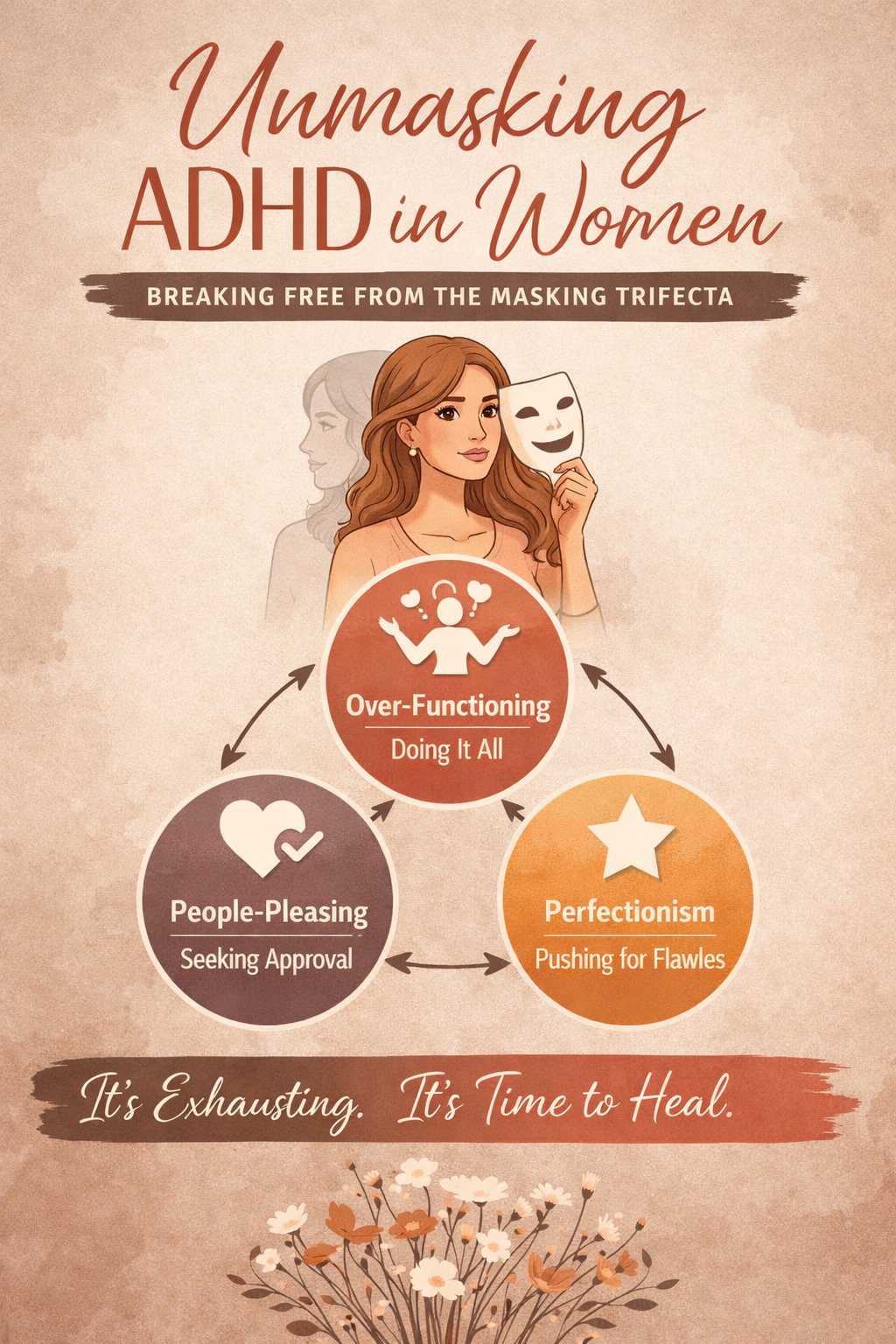
It usually shows up as a trifecta:
Over-functioning
Doing more than your share. Carrying responsibility others don’t see. Holding everything together so nothing falls apart.
People-pleasing
Tracking others’ emotions. Anticipating needs. Avoiding conflict. Saying yes when your body wants to say no.
Perfectionism
Trying to get it “right” so you won’t be criticized, misunderstood, or seen as unreliable. Mistakes feel dangerous, not neutral.
These aren’t personality flaws.
They are adaptive strategies that once helped you belong, succeed, or stay emotionally safe.
And for a while, they work.
Until they don’t.
Why Masking Is So Exhausting (A Nervous System Lens)
Masking takes energy. A lot of it.
From a nervous system perspective, masking keeps you in a state of constant self-monitoring:
How am I coming across?
Am I doing this right?
Am I too much? Not enough?
That vigilance taxes your system.
Over time, many women experience:
chronic fatigue
anxiety or depression
burnout
loss of self-trust
difficulty accessing joy or creativity
Not because they’re weak — but because they’ve been living in performance mode instead of safety.
True regulation doesn’t come from holding yourself together harder.
It comes from feeling internally supported.
Masking Isn’t the Opposite of Confidence — It’s Often Mistaken For It
Here’s one of the most important distinctions I want to make:
Masking can look like confidence.
But it isn’t the same thing.
Confidence rooted in masking depends on:
approval
performance
external validation
never dropping the ball
Confidence rooted in internal safety looks different.
It shows up as:
self-trust
flexibility
boundaries
choice
This is why many women who “have it all together” feel the least confident inside. Their confidence has been outsourced.
Is Unmasking Always the Goal?
No.
Unmasking isn’t something you owe anyone.
And it’s not always safe or appropriate to do everywhere.
What is essential is having choice.
When masking becomes automatic — when you don’t even know you’re doing it — it can quietly erode your well-being. Too much masking, for too long, often leads to inner distress… and eventually illness.
The goal isn’t to rip the mask off.
The goal is to build enough internal safety that you don’t need it all the time.
What Actually Replaces Masking
What replaces masking isn’t exposure or over-sharing.
It’s:
understanding your nervous system
learning when you’re over-functioning instead of choosing
recognizing people-pleasing as protection, not identity
letting go of perfectionism as safety
And slowly rebuilding confidence from the inside out.
This is the work of self-trust — not self-correction.
Want to Understand Masking More Deeply?
If this resonated — if you recognized yourself in the masking, the over-functioning, or the quiet exhaustion — I explore this more deeply in my YouTube video:
Stop Masking ADHD: How True Confidence Comes From Within
https://youtu.be/4QgN5Zm6z5o
On my channel, I talk about ADHD from the inside out — with nuance, compassion, and a nervous-system-informed lens that honors how women actually live.
You don’t have to stop masking everywhere.
But you do deserve spaces where you don’t have to hold it all together.
Rebuilding Confidence Beneath the Mask
If masking has been your way of staying safe — and you’re starting to feel the cost of carrying it — you might appreciate my journal-book experience,
The Self-Loved ADHD Woman Way: How to Stop Playing Small with ADHD.
It’s a guided, reflective space designed to help ADHD women reconnect with themselves beneath the strategies, roles, and expectations — at a pace that honors your nervous system, not pressures it.
You can learn more about it here:
https://jenbarnes.org/stop-playing-small/