Your cart is currently empty!
Author: jenbarnes
-

Why ADHD Women Buy Online Courses They Never Finish
If you’re an ADHD woman who has bought an online course you never finished, you’re not alone.
In fact, you might have bought several.
I know this because I’ve worked with ADHD women for years. But I also know it because I’ve lived it myself.
At one point I looked back and realized that in just two years I had purchased over 16 online courses.
I completed three.
Some I never even opened.
That realization was painful. It meant I had spent thousands of dollars on programs that didn’t actually change anything for me.
And I’m not the only one. I once had a woman join my program, ASCEND: The ADHD Women’s Mastery Program, who had done the exact same thing I had — buying more courses than she could realistically complete, creating a pile of unfinished programs and a growing amount of debt.
When this happens, most ADHD women assume the problem is them.
They think it means they’re bad at follow-through.
But in many cases, that’s not actually the real problem.
Why ADHD Women Buy So Many Online Courses
There are a few reasons ADHD brains are especially vulnerable to buying courses.
First, they’re interesting.
ADHD brains are naturally drawn to novelty and learning. When a course promises a solution to something we care about — improving our business, getting organized, understanding our ADHD, fixing our habits — it lights up that curiosity.
Second, many courses hit something deeper: the feeling that this is something we should already know.
When marketing taps into that feeling, it can create a sense of urgency. The message becomes:
“If you don’t learn this right now, something in your life or business might suffer.”
I’ve noticed that sometimes this creates a feeling of panic in me.
The moment feels urgent. Like I need to learn this thing right now or I’m going to fall behind.
Online course creators often use urgency intentionally in their marketing — countdown timers, limited enrollment, bonuses that disappear. Those tactics work on many people, but they can be especially hard for impulsive ADHD brains to resist.
So we buy.
Often we buy more courses than we actually have time to complete.
Why ADHD Women Don’t Finish Them
Here’s the irony.
The same brain that bought the course with dopamine has to finish it with executive function.
And those are not the same systems.
When something is new and exciting, ADHD brains get a surge of dopamine. That novelty fuels motivation and action.
But completing a course usually requires something very different:
-
sustained attention
-
organization
-
delayed rewards
-
planning when to watch and implement
That’s executive function territory.
If the course sits untouched for a while, it also loses its novelty. The longer we wait to start, the harder it becomes to begin.
In my experience, the best time to start a course is the moment you buy it. The further you move away from that moment, the more the motivation fades.
There are also nervous system factors at play. If the course feels too big, too complicated, or too ambiguous, many ADHD brains move into a kind of shutdown response. It’s the classic “bit off more than you can chew” situation.
Add overwhelm, time blindness, and difficulty with delayed rewards, and it’s easy to see why courses remain unfinished.
The Way Most Online Courses Are Designed
There’s another issue most people don’t talk about.
Many online courses are simply not designed for ADHD learning styles.
Common course features that overwhelm ADHD women include:
-
huge libraries with dozens of lessons
-
long videos that run 30–60 minutes
-
no clear order of where to begin
-
too many downloads and worksheets
-
unclear outcomes
-
“lifetime access” platforms that feel endless (and basically reinforces putting it off)
Instead of helping, these designs can make it harder to start.
The course becomes another large, ambiguous project sitting on your mental to-do list.
And when something feels that big, the ADHD brain often avoids it.
The Emotional Toll of Unfinished Courses
This pattern doesn’t just affect productivity. It affects how women feel about themselves.
I frequently hear ADHD women express:
-
shame about wasted money
-
embarrassment about unfinished courses piling up
-
the belief that they are “bad at follow-through”
But the problem is often not a character flaw.
The problem is that most courses are built for neurotypical learning patterns.
What ADHD Brains Actually Need to Follow Through
Over time I’ve noticed that ADHD women are much more likely to complete and implement programs that include a few key elements.
1. Human support
Direct contact with the person teaching the material makes a big difference. This might include 1:1 sessions or direct coaching.
2. Scheduled accountability
Appointments where someone expects you create structure. When something is on the calendar, the ADHD brain is much more likely to show up.
3. Shorter timelines
Programs that run two or three months are easier to complete than large self-paced libraries that stretch indefinitely.
4. Structured pacing
Clear steps and a defined order help reduce overwhelm.
5. A specific outcome
Programs that focus on one clear transformation tend to work better than ones promising to “fix everything.”
Interestingly, the programs I have personally completed all included these elements.
For example, I joined a Mystery School that has weekly meetings, coaching from the teacher who created it, and support from a cohort moving through the material together.
That structure made all the difference.
When Self-Paced Courses Do Work
Occasionally self-paced courses can still work for ADHD brains.
For me, I once completed a course on using Google tools for organization.
But there was a specific reason.
Organization happens to be a special interest of mine.
Even though the course itself wasn’t especially well designed — the videos were slow and full of fluff — the topic itself was interesting enough to sustain my attention.
But I wouldn’t rely on that happening again.
Interest alone isn’t always enough to overcome the structural challenges ADHD brains face.
The Shift Most ADHD Women Need
If you’ve bought courses you didn’t finish, it doesn’t necessarily mean you lack discipline.
It may simply mean the learning format didn’t match how your brain works.
ADHD brains tend to do better with:
-
structure
-
pacing
-
human support
-
accountability
When those elements are missing, even the most motivated person can struggle to follow through.
A Different Approach to Follow-Through
If you’ve ever bought a course you never finished, you’re not alone.
And you’re probably not the problem.
Many ADHD women simply need learning environments that include structure and accountability — not just a library of videos.
I’m currently developing something specifically designed to address the follow-through piece for ADHD women.
If you’d like to hear about it when it opens, you can join the Priority Notification List for the No-Dropped Balls Challenge here.
It’s designed to help ADHD women move from ideas and intentions into actual follow-through.
Want ideas for getting stuff done NOW?
Check out a recent blog post I wrote here called How to Get Things Done with ADHD.
AND, if you’ve ever blamed yourself for not finishing courses, you’re not alone. A big part of moving forward with ADHD is learning to work with your brain instead of against it. I talk more about the first step in this video: The Missing ADHD Piece That Changes Everything.
If you want ADHD strategies and support sent straight to your inbox, join my email club here for professional women with ADHD: https://jenbarnes.kit.com/email-club

-
-

Which Planners Work Best for Women with ADHD at Work?
If you’re a professional woman with ADHD, chances are you’ve bought more than one planner in your life.
Maybe a lot more.
You probably bought the new planner thinking, This one will finally help me stay organized.
And for a little while… it might have.
But then something happened. The planner stopped working the way you hoped it would. Maybe you forgot to use it. Maybe it felt overwhelming. Maybe it became another thing on your list of things you were supposed to keep up with.
If that’s happened to you, you’re not alone.
And it doesn’t mean you’re doing ADHD wrong.
The Truth About “The Best Planner” for ADHD
People often ask me:
Which planner works best for women with ADHD in the workplace?
It’s an understandable question. When your days are full of meetings, deadlines, projects, and administrative tasks that are easy to forget, of course you want the system that will finally make everything feel manageable.
The problem is this:
There isn’t one best planner.
The planner that works best depends on the person, the type of work they do, what their ADHD looks like, and even what is happening in their life at that moment.
A system that works beautifully for someone one year might stop working the next.
That’s not failure.
That’s actually very consistent with how ADHD brains work.
A Pattern I See Over and Over
One of the most common frustrations I hear from ADHD women in the workplace is that the productivity system becomes the focus instead of the support.
They start with something simple.
Then the system becomes more complicated. New lists appear. Sticky notes multiply. A task app fills with one giant list. Or a digital system becomes a whole project of its own.
I even had a client who loved building beautiful boards in Notion.
The problem was that creating the system became the activity instead of doing the work.
This happens because ADHD brains can be drawn to novelty and stimulation. Designing the system can feel rewarding and interesting. But the system is supposed to be scaffolding — not the main event.
The Real Work Demands ADHD Women Are Managing
Many of the women I work with are professionals juggling complex responsibilities.
Psychotherapists, occupational therapists, attorneys, engineers, accountants, entrepreneurs, healthcare administrators, and corporate professionals.
Their days often include:
• meetings and client work
• projects with multiple moving parts
• deadlines and deliverables
• administrative tasks that are easy to forget
• marketing or business development (for entrepreneurs)A planner or task system needs to support that reality without becoming another burden.
Digital or Paper? Start Here.
One of the first questions to ask is whether someone prefers a digital system or a paper planner.
Neither is inherently better for ADHD.
It depends on how your brain works.
Digital systems can help when:
• you rely on reminders and notifications
• you forget about tasks unless something prompts you
• you need portability
• you want integration with email or calendarPaper systems can help when:
• you want to be on your phone less
• you think better by writing things down
• seeing the planner physically helps you remember to use itThere’s also a third option many ADHD women prefer:
A hybrid system.
For example, I personally track tasks digitally using Akiflow, but I also use a notebook to set intentions for my week and jot down ideas.
The notebook I’m currently enjoying is the Leuchtturm1917 Bullet Journal notebook, which has an index that makes it easy to find things later. I also like that it simply feels good to use — the texture of the notebook, the sound when you open it, even the aesthetics.
Those sensory details might sound small, but for ADHD brains they can actually make a system more engaging.
A Few Tools ADHD Women Often Experiment With
There isn’t one perfect tool, but these are a few systems I’ve seen work well for many people:
Akiflow – a digital task manager that integrates with email and calendar. (Note, this is my affiliate link so both you and I will have a small benefit from you following the link to Akiflow)
Google Calendar + Google Tasks – a simple system that works well for people already using Gmail.
Trello – a visual Kanban-style board that can be especially helpful for large projects with many moving pieces.
A simple notebook or undated planner – flexible and easy to pick up again if you fall off for a while.
The key is not which tool you choose.
It’s whether the tool fits how your brain works.
Why I Recommend Undated Planners
Many ADHD women have what I call a touch-and-go relationship with planners.
You might use one daily for a while, then stop for a week or a month.
When planners are dated, that gap can trigger shame.
Suddenly you’re flipping through pages of unused days and thinking:
I should have kept up with this.
Undated planners remove that pressure. You can stop and restart without feeling like you’ve failed.
A Word About Time Blocking
Time blocking is often recommended in productivity advice.
But for some ADHD brains, it can backfire.
When I see a task scheduled at a specific time, I sometimes feel an internal reaction that sounds like:
You can’t make me.
It’s a classic example of demand avoidance.
Instead of doing the task, I might suddenly check email, scroll social media, or even start cleaning — activities I normally wouldn’t choose.
There can also be a sense of pressure in the body, almost like anxiety. It can activate the fight-or-flight response, which makes it harder to do the task from a grounded place.
For creative work, it can even feel like the time block kills the creativity.
Instead of strict time blocking, I often suggest something simpler:
Look at how much open time you have in a day.
Decide what feels reasonable to accomplish.
Set intentions for the day rather than rigid time slots.Then start with what feels most aligned in that moment.
When You Keep Abandoning Planners
If you’ve bought multiple planners and stopped using them, it doesn’t mean you lack discipline.
ADHD brains naturally respond to novelty.
Sometimes a planner stops working simply because it stopped being interesting.
If switching planners becomes expensive or time-consuming, you might experiment with adding novelty instead of replacing the system.
For example:
• different color pens
• stickers or visual cues
• creative layouts
• gamifying how you engage with the plannerSometimes a small refresh can bring a system back to life.
The Real Goal of a Planner
When women ask about the best planner, they are usually hoping for something deeper than just organization.
They want to:
• feel more in control of their time
• reduce the mental chaos of multiple lists
• remember deadlines without constantly worrying about them
• feel less overwhelmed at workA planner can help with those things.
But only if it stays simple enough to remain a support instead of another source of pressure.
The Most Helpful Way to Think About It
Instead of searching for the perfect planner you will use forever, try thinking about your planning system as something that evolves with you.
Every system you try teaches you something.
What worked.
What didn’t.
What your brain actually prefers.
Over time, that experimentation leads you toward a system that fits you better and better.
Not perfectly.
But well enough to support the work you want to do in the world.
Productivity Challenge
If planners haven’t solved the “things falling through the cracks” problem for you, the issue probably isn’t the planner.
It’s the system underneath it. Inside my No-Dropped-Balls Productivity Challenge, I teach ADHD women how to build that system. You can join the Priority Notification List here to hear when the next round opens.
Want more great ADHD content?
Check out these resources:
The Self-Loved ADHD Woman Way podcast
Join my email club for professional women with ADHD here
-

ADHD and Phone Addiction: Why It’s So Hard to Stop (and What Actually Helps)
If you have ADHD, you probably already know the moment I’m talking about.
You open your phone to do one simple thing…
And then you “wake up” 27 minutes (or two hours) later with 14 tabs open, three half-finished messages, and a nervous system that somehow feels both overstimulated and under-fueled.
And the shame voice is right there:
“Why can’t I just stop?”
But here’s what I want you to know right away:
This isn’t about willpower.
For many ADHD women, phone overuse isn’t just a “bad habit.”
It’s a regulation strategy.
It’s your brain trying to create focus, relief, connection, stimulation, or escape… in the fastest way available.
Let’s unpack what’s really going on.
The Real Link Between ADHD and Phone Addiction
Smart phones are basically a perfect match for an ADHD nervous system on a hard day.
They offer:
Novelty
Instant rewards
Social input
Endless stimulation
A quick exit ramp from discomfort
And if you’re an ADHD woman who’s been over-functioning for years, your system may be running on “keep it together” energy all day…
So when your brain finally gets a chance to reach for relief, it reaches for the fastest thing.
Your phone.
Not because you’re weak.
Because your brain is efficient.
It’s not “low dopamine.” It’s a reward + attention system that gets pulled hard.
You’ll hear people say, “ADHD is low dopamine,” but that’s an oversimplification.
What matters more for daily life is that ADHD brains often have differences in how they regulate:
Motivation
Attention shifting
Reward anticipation
Inhibition (pause-before-click)
That means a phone’s design (scrolling, notifications, quick hits, endless novelty) can hook attention fast… and keep it there.
Not because you’re addicted to your phone as a device.
But because the experience is intensely rewarding to an ADHD brain.
It’s Not Just ADHD. Stress and Social Strain Matter, Too.
In a study of middle school students, smartphone addiction was most strongly predicted by:
Stress
Interpersonal problems
And (when it came to what people used phones for) social networking and music/videos were the biggest drivers of problematic use.
That matters because it supports something I see constantly in ADHD women:
When life feels socially complicated, emotionally heavy, or chronically stressful…
Phones don’t just distract us.
They regulate us.
They soothe.
They numb.
They give us connection without vulnerability.
They give us stimulation without effort.
And it can become a loop.
Common Signs Your Phone Use Has Become a “Regulation Loop”
Phone use becomes a problem when it’s no longer a choice.
Here are a few patterns I see often:
1) The reflex check
You reach for your phone without deciding to.
Bathroom.
Car.
Elevator.
Waiting for the microwave.
You don’t even notice you picked it up.
2) “I need it to start” (or “I need it to calm down”)
You use your phone to rev up or to settle down.
A little stimulation to get moving.
A little scrolling to come down.
And then it becomes the bridge you can’t stop using.
3) You feel edgy or anxious without it
Not having your phone nearby makes your body feel unsettled.
Not because you’re dramatic.
Because your nervous system is used to having an immediate outlet.
4) You lose time in a way that scares you
“I swear it was 5 minutes.”
But it was 45.
That time distortion can be especially strong for ADHD brains.
5) It worsens sleep, mood, and patience
If you’re sleeping worse, feeling more irritable, more scattered, more emotionally reactive…
It’s worth considering whether your phone is part of the nervous system load.
Why “Just Use Self-Control” Usually Fails
Most advice about phone addiction assumes you have steady, consistent self-regulation available on demand.
But ADHD doesn’t work that way.
If your day is filled with:
masking
over-functioning
decision fatigue
emotional labor
pressure to perform
…then by evening (or even by mid-afternoon), your brain is not looking for a moral lesson.
It’s looking for relief.
So instead of aiming for “never scroll,” we want a plan that actually matches how ADHD works.
What Actually Helps: ADHD-Friendly Strategies That Don’t Rely on Willpower
Here are the strategies that tend to work best for ADHD women because they reduce friction, reduce cues, and support nervous system regulation.
1) Change the “start cue”
Most phone spirals begin with one cue:
Boredom
Discomfort
Uncertainty
Loneliness
Overwhelm
So we want to interrupt the cue with a tiny replacement.
Try a 10-second swap:
Stand up and stretch
Sip water
Look outside
Put your hand on your chest and take one slow, honest breath (notice it first… then invite it to slow)
You’re not trying to become a new person.
You’re giving your brain a different doorway.
2) Make the phone less rewarding
This is where simple design changes matter.
Move social apps off your home screen.
Turn off non-essential notifications.
Use Focus Modes for work blocks.
Put your most tempting apps in a folder called “Not Now.”
You’re not removing your phone.
You’re reducing the “instant reward.”
3) Build “friction” on purpose
ADHD brains are momentum-based.
If it’s easy, we do it.
If there’s a pause, we can choose.
A few options:
Log out of your most-scroll apps
Remove saved passwords
Set a 1-minute screen time limit for the biggest trigger app (even if you override it, the pause helps) – the app ScreenZen is even better than the built-in options for this, or if you really want to get serious, you could try Brick.
Use an app like One Sec or similar “speed bump” tools
4) Create phone-free zones that protect your nervous system
Not as punishment.
As support.
Two of the most powerful:
Bedroom (sleep protection)
Kitchen table (connection protection)
Even if you start with 2 nights a week, it counts.
5) Replace the need, not just the behavior
This is the part most posts miss.
Your phone is meeting a need.
Ask yourself:
What is my phone giving me right now?
Stimulation?
Escape?
Connection?
Comfort?
Certainty?
Then choose a replacement that matches the need:
If you need stimulation: music while you do one tiny task
If you need comfort: warm drink + weighted blanket + one episode on TV (intentional, not endless scrolling)
If you need connection: voice memo a friend, or text one person intentionally
If you need escape: 10-minute walk, shower, or lying down with eyes closed
We’re not trying to become screen-free.
We’re becoming choice-full.
6) Try the “Two-Lane” plan
This is one of my favorite ADHD-friendly approaches.
Lane 1: “I’m using my phone intentionally.”
Examples: text a friend, look up a recipe, play a podcast, do a 5-minute timer.Lane 2: “I’m in a scroll loop.”
When you notice you’re in Lane 2, your job isn’t to shame yourself.Your job is to reset.
Reset options:
Stand up and walk to the other room
Put the phone face down
Set a 3-minute timer and do something physical
Then decide what you actually want next.
7) Protect your transitions
Transitions are where ADHD brains get snagged.
Try a rule like:
“No phone during transitions.”
Not forever.
Just:
first 10 minutes after waking
first 10 minutes after getting home
first 10 minutes after sitting down to work
Those are high-leverage moments.
If This Feels Bigger Than Habits
Sometimes phone overuse isn’t mainly about distraction.
It’s about emotional load.
If you’re using your phone to numb, collapse, or disappear at the end of the day…
That can be a sign your system is spending too much time in fight/flight or shutdown.
And if that’s true, the answer isn’t stricter rules.
The answer is deeper support.
Support for regulation.
Support for boundaries.
Support for self-trust.
Support for a life that doesn’t require you to recover from it every night.
Want more?
If this hit close to home, I’ve created two YouTube videos that go deeper into ADHD phone distraction and what actually helps.
ADHD & Phone Addiction: 5 Shocking Truths You Need To Know
Beat Phone Distraction With These Easy Tricks
You can find both on my YouTube channel here:
https://www.youtube.com/@Jenbarnes
A Gentle Invitation for ADHD Women
If you’re realizing your phone has become a way to stay afloat…
And you want a deeper, kinder way to rebuild self-trust beneath the coping…
You might appreciate my journal-book experience:
The Self-Loved ADHD Woman Way: How to Stop Playing Small with ADHD
It’s a guided, reflective space designed to help ADHD women reconnect with themselves beneath the habits, strategies, and pressure — at a pace that honors your nervous system, not pushes it.
You can learn more about it here:
-

Is It ADHD or Trauma? How to Tell the Difference (And Why It Matters)
Many adults—especially women—come to me with the same quiet question:
“Is this really ADHD… or is it trauma?”
They’re not asking out of curiosity.
They’re asking because they’ve tried productivity systems, medication, therapy, self-help—and still feel stuck, overwhelmed, or chronically dysregulated.This question matters because ADHD and trauma can look strikingly similar on the surface, yet require very different kinds of support. And when we miss that distinction—or assume it has to be either/or—people often end up feeling worse, not better.
Let’s slow this down and look at what’s actually happening.
ADHD and Trauma: Why the Confusion Is So Common
ADHD is a neurodevelopmental condition that affects attention regulation, impulse control, working memory, and executive functioning.
Trauma, particularly chronic or developmental trauma, shapes the nervous system around safety and survival.
From the outside, both can present as:
- Difficulty focusing
- Disorganization and task paralysis
- Emotional reactivity
- Restlessness or shutdown
- Trouble following through
But the why underneath these behaviors is not the same.
That’s where things get missed.
Where ADHD and Trauma Overlap
ADHD and trauma often overlap in symptoms because both affect how the brain and nervous system process information.
Here’s a simplified way to think about it:
- ADHD struggles often stem from difficulty regulating attention and effort
- Trauma struggles often stem from difficulty regulating safety and arousal
When the nervous system doesn’t feel safe, focus naturally becomes harder.
When attention regulation is already challenging, stress hits harder.This overlap is why misdiagnosis is common—and why many adults feel confused after receiving an ADHD diagnosis that doesn’t fully explain their experience.
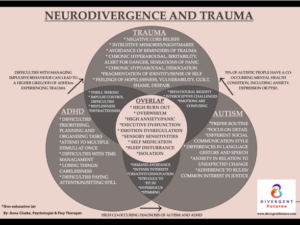
Venn Diagram: Shared vs. Distinct Symptoms
The following Venn diagram illustrates the overlap and differences between ADHD and trauma-related symptoms.

Shared symptoms may include:
- Inattention or “spacing out”
- Emotional overwhelm
- Difficulty with organization and planning
- Restlessness or agitation
More typical of trauma (not ADHD alone):
- Hypervigilance
- Intrusive thoughts or memories
- Avoidance behaviors
- Physiological stress symptoms (racing heart, nausea, muscle tension)
- Dissociation or emotional numbing
More typical of ADHD (not trauma alone):
- Chronic time blindness
- Excessive talking or interrupting
- Difficulty sustaining effort even in safe, calm environments
- Lifelong patterns present across many contexts
Venn diagram adapted from training materials by Anna Clarke, used here with attribution and permission.
One of the Most Important Questions to Ask
Instead of asking:
“What’s wrong with me?”A more useful question is:
“Did these symptoms exist before stress and adversity—or did they intensify after?”Here’s a general guideline clinicians use:
- ADHD symptoms tend to be consistent across environments and present early in life (diagnostically prior to age 12)
- Trauma-related symptoms often fluctuate with safety, stress, and relational context
This doesn’t mean it’s one or the other.
Many people—especially women with late diagnoses—have both ADHD and trauma, and the interaction between them can amplify symptoms in powerful ways.
Why “Safety First” Matters
One of the biggest mistakes I see is trying to treat attention challenges without first addressing nervous system regulation.
When someone’s system is in fight, flight, freeze, or shutdown:
- Focus tools don’t stick
- Productivity strategies feel impossible
- Medication alone may increase anxiety or agitation
This doesn’t mean ADHD medication is wrong.
It means regulation must come first.A nervous system that doesn’t feel safe cannot sustain attention—no matter how motivated or capable someone is.
So… Is It ADHD, Trauma, or Both?
Often, the answer is both/and.
ADHD can increase vulnerability to trauma.
Trauma can intensify ADHD traits.
And chronic masking can blur the lines even further.That’s why accurate assessment, nervous system awareness, and compassionate pacing matter so much—especially for high-functioning women who have spent years pushing through.
Want to Go Deeper?
If this topic resonates, I’ve explored it more fully in these two YouTube videos:
Is It ADHD or Trauma? Find Out Now!
The Hidden Trauma Behind ADHDBoth break this down in an accessible, nervous-system-informed way and may help you notice patterns you hadn’t seen before.
A Gentle Next Step
If you’re realizing that willpower, pressure, and “trying harder” haven’t worked—and you’re craving a more compassionate, body-aware approach—
✨ The Self-Loved ADHD Woman Way: How to Stop Playing Small with ADHD is a guided journal-book experience designed to help you slow down, regulate your nervous system, and reconnect with yourself without fixing or forcing.
It’s not about labels.
It’s about learning how your system works—and meeting it with care.You can learn more here:
👉 https://jenbarnes.org/stop-playing-small/ -

Stop Masking ADHD: Why High-Achieving Women Burn Out (and What’s Underneath)
If you’re a woman with ADHD who looks confident, capable, and “put together” on the outside — but feels exhausted, anxious, or disconnected on the inside — masking may be playing a bigger role than you realize.
Many high-achieving ADHD women don’t struggle because they lack skills or motivation. They struggle because they learned, very early on, how to hide parts of themselves in order to stay safe, accepted, and successful.
This post isn’t about telling you to “just unmask” or “be yourself.”
It’s about understanding why masking worked, what it costs, and what actually creates true confidence from within.What ADHD Masking Really Is (and Why Women Learn It Early)
ADHD masking is the process of suppressing, compensating for, or hiding ADHD traits in order to meet external expectations.
For many women, masking starts in childhood.
Girls are often rewarded for being:
quiet
helpful
emotionally aware
responsible
easy to manageSo when ADHD shows up — through distraction, emotional intensity, restlessness, or inconsistency — many girls learn to adapt, not disrupt.
They don’t get labeled as “a problem.”
They get labeled as “mature,” “sensitive,” or “hard on themselves.”Masking becomes a survival strategy — not a flaw.
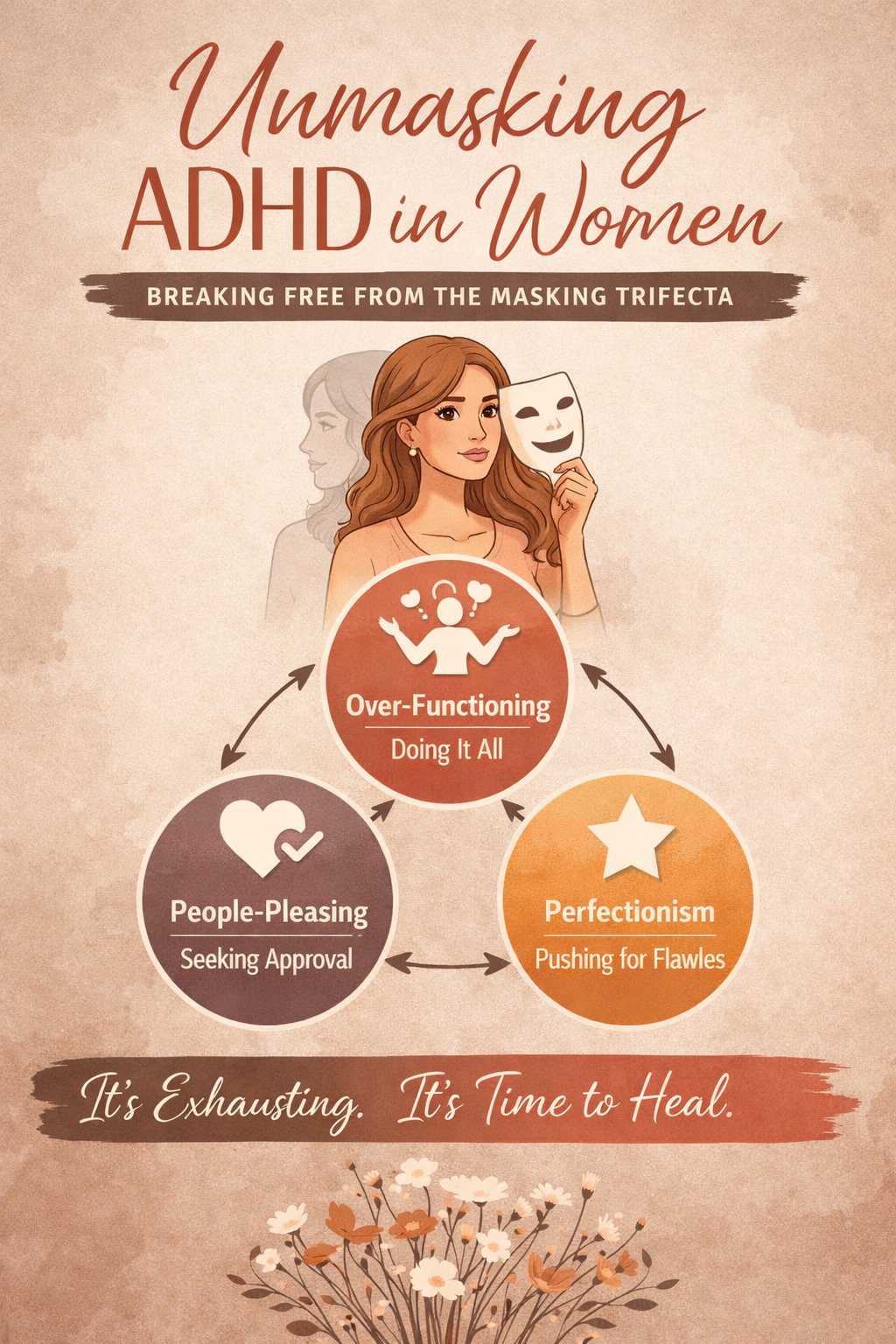
The Masking Trifecta Many High-Achieving Women Develop
Over time, masking often consolidates into a powerful pattern I see again and again in high-achieving ADHD women.
It usually shows up as a trifecta:
Over-functioning
Doing more than your share. Carrying responsibility others don’t see. Holding everything together so nothing falls apart.People-pleasing
Tracking others’ emotions. Anticipating needs. Avoiding conflict. Saying yes when your body wants to say no.Perfectionism
Trying to get it “right” so you won’t be criticized, misunderstood, or seen as unreliable. Mistakes feel dangerous, not neutral.These aren’t personality flaws.
They are adaptive strategies that once helped you belong, succeed, or stay emotionally safe.And for a while, they work.
Until they don’t.
Why Masking Is So Exhausting (A Nervous System Lens)
Masking takes energy. A lot of it.
From a nervous system perspective, masking keeps you in a state of constant self-monitoring:
How am I coming across?
Am I doing this right?
Am I too much? Not enough?That vigilance taxes your system.
Over time, many women experience:
chronic fatigue
anxiety or depression
burnout
loss of self-trust
difficulty accessing joy or creativityNot because they’re weak — but because they’ve been living in performance mode instead of safety.
True regulation doesn’t come from holding yourself together harder.
It comes from feeling internally supported.Masking Isn’t the Opposite of Confidence — It’s Often Mistaken For It
Here’s one of the most important distinctions I want to make:
Masking can look like confidence.
But it isn’t the same thing.Confidence rooted in masking depends on:
approval
performance
external validation
never dropping the ballConfidence rooted in internal safety looks different.
It shows up as:
self-trust
flexibility
boundaries
choiceThis is why many women who “have it all together” feel the least confident inside. Their confidence has been outsourced.
Is Unmasking Always the Goal?
No.
Unmasking isn’t something you owe anyone.
And it’s not always safe or appropriate to do everywhere.What is essential is having choice.
When masking becomes automatic — when you don’t even know you’re doing it — it can quietly erode your well-being. Too much masking, for too long, often leads to inner distress… and eventually illness.
The goal isn’t to rip the mask off.
The goal is to build enough internal safety that you don’t need it all the time.What Actually Replaces Masking
What replaces masking isn’t exposure or over-sharing.
It’s:
understanding your nervous system
learning when you’re over-functioning instead of choosing
recognizing people-pleasing as protection, not identity
letting go of perfectionism as safetyAnd slowly rebuilding confidence from the inside out.
This is the work of self-trust — not self-correction.
Want to Understand Masking More Deeply?
If this resonated — if you recognized yourself in the masking, the over-functioning, or the quiet exhaustion — I explore this more deeply in my YouTube video:
Stop Masking ADHD: How True Confidence Comes From Within
https://youtu.be/4QgN5Zm6z5oOn my channel, I talk about ADHD from the inside out — with nuance, compassion, and a nervous-system-informed lens that honors how women actually live.
You don’t have to stop masking everywhere.
But you do deserve spaces where you don’t have to hold it all together.Rebuilding Confidence Beneath the Mask
If masking has been your way of staying safe — and you’re starting to feel the cost of carrying it — you might appreciate my journal-book experience,
The Self-Loved ADHD Woman Way: How to Stop Playing Small with ADHD.It’s a guided, reflective space designed to help ADHD women reconnect with themselves beneath the strategies, roles, and expectations — at a pace that honors your nervous system, not pressures it.
You can learn more about it here:
https://jenbarnes.org/stop-playing-small/ -

Do You Have ADD or ADHD? Why So Many Women Were Missed
If you’ve ever thought, “I don’t think I have ADHD… I think I have ADD,” you’re not alone.
I hear this from women all the time — especially women who are thoughtful, sensitive, high-functioning, and exhausted. Women who have been told they’re anxious, burned out, or just “too hard on themselves,” but who sense there’s something deeper going on.
So let’s talk about it.
Because the difference between ADD and ADHD isn’t just about terminology.
It’s about how generations of women were misunderstood — and why so many never got the clarity or support they deserved.ADD vs ADHD: What Changed (and What Didn’t)
ADD — Attention Deficit Disorder — hasn’t been an official diagnosis since 1994.
Clinically, everything now falls under ADHD (Attention-Deficit/Hyperactivity Disorder), with three presentations:
- Inattentive
- Hyperactive-Impulsive
- Combined
But while the diagnostic language changed, the lived language didn’t.
ADD is a term many women still use because it was the word applied to girls who weren’t disruptive, impulsive, or “too much.” It became shorthand for a quieter, internal experience of ADHD.
It’s a bit like an outdated job title.
The profession changed, but people kept using the old name because it still felt familiar — and because it fit how their experience had been described.So if the word ADD still resonates with you, that doesn’t mean you’re uninformed.
It means you grew up in a system that didn’t yet have language for how ADHD shows up in girls and women.Why So Many Women’s ADHD Was Missed Entirely
Here’s the part that matters most.
Many women weren’t misdiagnosed.
They were missed.Girls were often socialized to be:
- Quiet
- Helpful
- Sensitive
- Responsible
- “Mature for their age”
So when inattentive ADHD showed up as daydreaming, overwhelm, emotional sensitivity, or mental drift — especially when that sensitivity was directed inward — it didn’t look disruptive.
It looked like:
- Being a good kid
- Trying hard
- Taking things seriously
- Struggling privately
Doctors, teachers, and even parents didn’t see ADHD.
They saw anxiety.
Or depression.
Or a conscientious child who was “just a little overwhelmed.”And the ADHD diagnosis never came.
Many women grew up learning to function, perform, and compensate — without ever understanding why everything felt so effortful on the inside.
Your symptoms weren’t smaller.
They were quieter.The Nervous System Layer Many Women Experience (An Observation)
There’s another pattern I see again and again in adult women who resonate with the term ADD — and I want to be clear about how I’m naming this.
This is not a DSM category.
It’s not a new diagnosis.
It’s an observation from years of working with ADHD women.For many women, inattentiveness isn’t constant — it shows up most strongly when the nervous system is overloaded.
When life gets too loud.
Too demanding.
Too emotionally heavy.In those moments, focus doesn’t just wander — it collapses.
The mind fogs.
Thoughts slow.
Everything feels distant or frozen.This can look like procrastination or lack of motivation on the outside.
But internally, it’s often a freeze or shutdown response — the nervous system pulling the brakes because the load is too high.I see this especially when tasks or to-do lists feel overwhelming. Motivation drops not because the woman doesn’t care, but because her system doesn’t have the capacity to mobilize.
What looks like “I can’t focus” is often really “I’m overloaded.”
And when women learn to recognize these states — and support their nervous system instead of fighting it — their ability to start, focus, and follow through often improves dramatically.
ADHD Presentations — and Why Your Experience Can Change
ADHD is diagnosed by presentation, not by how it feels in every season of life.
Most adult women fall into the inattentive or combined presentations, which often include internal hyperactivity:
- Racing thoughts
- Emotional sensitivity
- Mental restlessness
- A constant internal load
Here’s an important nuance that often gets missed:
Your official ADHD presentation stays the same, but your experience of ADHD can shift depending on stress, hormones, trauma, burnout, responsibilities, and nervous system capacity.
That’s why ADHD can feel very different at 25 than it does at 45.
Understanding your presentation isn’t about boxing yourself in.
It’s about understanding what kind of support actually serves you now.If You’re Still Wondering “Is It ADD or ADHD?”
If you’ve always felt more aligned with the word ADD, it doesn’t mean you’re wrong.
It may mean:
- Your ADHD has been primarily inattentive
- Your hyperactivity has been more internal, not external
- You learned early to mask and manage
- Your struggles have shown up as anxiety or exhaustion instead of disruption
And it may mean you’re only now starting to see the fuller picture.
Clarity doesn’t come from labels alone.
It comes from understanding how your brain and nervous system actually work together.Want to Explore This Further?
If this post helped something click — if you found yourself nodding or exhaling while reading — you may want to explore this topic more deeply.
I share weekly videos on my YouTube channel that reflect the real inner experience of ADHD women, not the stereotypes most of us grew up with.
You can find my channel here and continue learning in a way that feels grounded, compassionate, and actually helpful.
You’re not late.
You weren’t wrong.
And you’re not alone in this. -

How to Get Things Done With ADHD
How to Get Things Done With ADHD (Without Burning Yourself Out)
If you have ADHD, you probably already know what you need to do.
The problem isn’t knowledge.
It’s follow-through.Many professional women with ADHD describe feeling capable, intelligent, and motivated—yet inexplicably stuck when it comes time to start or finish tasks. This often gets mislabeled as procrastination, laziness, or lack of discipline.
In reality, difficulty getting things done with ADHD is multifactorial. It’s not just about motivation or willpower—it’s about how your brain, nervous system, energy, and emotional landscape interact.
Below is a therapy-informed framework I use consistently in my work with ADHD women to help them move from stuck to sustainable action—without pushing themselves into burnout.
Why Getting Things Done With ADHD Is So Hard
ADHD impacts:
-
Executive functioning (initiation, prioritization, task switching)
-
Emotional regulation
-
Nervous system responsiveness
-
Sensitivity to boredom, pressure, and overwhelm
This means many traditional productivity strategies—rigid schedules, forcing consistency, “just do it” approaches—work against the ADHD nervous system rather than with it.
Getting things done with ADHD requires alignment, not force.
1. Make the Task Interesting (But Not Overstimulating)
The ADHD brain is interest-based, not importance-based.
Tasks are more doable when they include:
-
Novelty (doing it differently, changing location, switching format)
-
Creativity (making it playful, visual, or expressive)
-
Challenge (clear parameters, time-boxing, gentle competition)
-
Connection (body doubling, accountability, shared presence)
-
Urgency (used sparingly) — if you’re a chronic procrastinator (and you probably are if you’re here), you are already using urgency. However, using it too much dysregulates your nervous system over and over and exacerbates ADHD symptoms making starting and completing tasks even harder.
If a task feels flat, vague, or endless, your nervous system may interpret it as a threat—not because it is one, but because it lacks stimulation or clarity.
The goal is not to force motivation, but to invite action, even small steps.
2. Regulate Your Nervous System Before You Push for Productivity
This is where many ADHD productivity conversations miss the mark.
If your nervous system is dysregulated—stuck in fight, flight, freeze, or shutdown—your capacity for focus and initiation drops dramatically.
Before trying to “get things done,” it helps to ask:
-
Am I activated (anxious, pressured, frantic)?
-
Am I shut down (foggy, heavy, avoidant)?
-
Am I resourced enough right now to begin?
Simple regulation strategies may include:
-
Noticing the breath as it is, then inviting it to slow
-
Gentle movement or grounding
-
Reducing sensory overload
-
Orienting to safety before action
This isn’t avoidance.
It’s preparation.When regulation comes first, productivity becomes more accessible—and far less costly.
3. Match the Task to Your Energy (Not the Clock)
One of the most overlooked ADHD productivity strategies is energy alignment.
Instead of asking, “What should I do right now?” try asking:
-
What kind of energy does this task require?
-
When do I naturally have that kind of energy?
For example:
-
Analytical or decision-heavy tasks → higher cognitive energy times (for me, this is first thing in the morning after my morning Self-Love Ritual)
-
Creative tasks → looser, more spacious windows
-
Administrative tasks → lower-energy or transition periods
Forcing high-demand tasks during low-energy windows often leads to procrastination that looks mysterious—but isn’t.
ADHD-friendly productivity respects rhythm, not rigid schedules.
4. Use ADHD-Friendly Supports (External Structure Is Not a Failure)
Many ADHD women have been taught they should be able to do things without help.
In reality, external supports are often essential—not because you’re incapable, but because ADHD brains benefit from visible structure.
Helpful supports may include:
-
A visual timer to reduce time blindness
-
A planning system that matches how you think (and recognizing this will need to be switched up from time to time to keep your ADHD brain interested in it)
-
Breaking tasks into visible, concrete steps (but only looking at three at a time)
-
Reducing friction between intention and action
-
Environmental cues that support follow-through
The right support system reduces decision fatigue and keeps tasks from living only in your head—where they tend to grow heavier.
Still Stuck? Look for Invisible ADHD Obstacles
If you’ve tried all of the above and still feel stuck, it may not be a productivity problem at all.
Invisible ADHD obstacles often include:
-
Fear of failure or success
-
Perfectionism as a protective strategy
-
Shame from years of internalized messaging
-
Emotional overwhelm tied to past experiences
-
Burnout that hasn’t been fully acknowledged
When these are present, pushing harder rarely helps.
This is where therapy—not tips or tools—often becomes the missing piece.
A More Sustainable Way Forward
Getting things done with ADHD isn’t about fixing yourself.
It’s about understanding:
-
What your nervous system needs
-
How your energy actually works
-
Where invisible barriers are quietly interfering
-
What support makes follow-through feel safer and more possible
When these pieces come together, many women notice:
-
Less self-blame
-
Fewer push-crash cycles
-
More consistency without pressure
-
A calmer relationship with productivity
Ready for Deeper Support?
If you’re tired of managing ADHD on your own and want structured, therapy-informed support, ASCEND: The ADHD Women’s Mastery Program is opening soon.
ASCEND is designed for professional women with ADHD who want to:
-
Address invisible obstacles, not just surface behaviors
-
Regulate their nervous system while building momentum
-
Develop sustainable systems that actually fit their lives
👉 Join the waitlist to be the first to know when ASCEND opens.
You don’t need more willpower.
You need support that understands how your ADHD actually works. -
-

Can I Purchase ADHD Therapy Programs That Combine Digital Tools and Live Therapy Sessions?
This is a question I hear often — especially from high-achieving ADHD women who are thoughtful, motivated, and frankly… tired of trying things that don’t stick. That is, “Are there ADHD therapy programs with digital tools?”
The short answer is: yes, these programs do exist.
But the more important question is whether this kind of support is right for you — and why combining therapy with digitaltools can be so powerful when done ethically and intentionally.Why “Only Therapy” or “Only Digital Programs” Often Fall Short for ADHD
Many women try to choose one lane:
They either commit to weekly therapy without structured skill-building support…
Or they invest in digital courses, planners, apps, and tools without live, relational support.
What I see again and again is that both approaches can help — but each has limitations on its own.
With therapy alone, sessions often end up focused on the most urgent issue of the week. Skills and strategies get introduced slowly, inconsistently, or get lost when life inevitably shifts. Progress happens — but it can take longer than necessary, which often means spending more money over time.
With digital programs alone, women frequently struggle to start, follow through, or complete the material. When that happens, it’s rarely framed as an ADHD issue — instead, it becomes internalized as “What’s wrong with me?” Shame creeps in. Motivation drops. And some women begin to believe they can’t be helped at all.
Neither outcome is fair — and neither reflects the reality of how ADHD brains work.
The Invisible Obstacles Tools Alone Don’t Address
One of the biggest myths about ADHD support is that women just need the right strategy.
In reality, many ADHD women are blocked not by lack of information, but by unseen emotional and nervous system barriers — often shaped by years of growing up in a neurotypical world that told them they were too much, not enough, or needed to be fixed.
These obstacles can look like:
-
Perfectionism that makes starting feel impossible
-
People-pleasing that drains energy needed for self-care
-
Fear of failure or success hiding underneath procrastination
-
Chronic over-functioning followed by burnout
-
Difficulty resting without guilt
No planner or app can resolve those on its own.
A Client Example (Shared Anonymously)
One woman I worked with was highly successful at work — organized, dependable, respected. And yet, outside of work, everything felt hard.
She had tried exercise routines, mindfulness practices, sleep schedules, planners — all the “right” tools. None of them stuck. She was confused by how capable she felt professionally and how stuck she felt personally. Shame quietly followed her.
What eventually helped wasn’t finding a better system.
It was addressing the underlying parts of her that carried old wounds around being “too much” and “not enough.” Once those were met with compassion and care, we were able to build sustainable, ADHD-friendly habits together — habits that finally worked because they were built on safety, not pressure.
Why Combining Therapy + Digital Tools Can Work So Well for ADHD
When done thoughtfully, a combined model allows each piece to do what it does best.
The digital component:
-
Teaches skills efficiently
-
Allows repetition (which ADHD brains need)
-
Frees therapy time from being purely instructional
-
Creates structure between sessions
The therapy component:
-
Addresses emotional blocks and unresolved wounds
-
Provides accountability and relational safety
-
Helps regulate the nervous system
-
Adapts strategies to your life and brain
Together, they support both capacity and follow-through.
How I Approach This in ASCEND: The ADHD Women’s Mastery Program
ASCEND: The ADHD Women’s Mastery Program was designed by an ADHD woman (me) with over 25 years in the mental health field — because I saw how often women needed both depth and structure.
ASCEND is an 8-week intensive, which matters. Most ADHD women need a clear container and a meaningful deadline to stay engaged and complete the work.
The program includes:
-
A foundational learning component so skills aren’t rushed or forgotten
-
Focused tracks so women can work on one ADHD challenge at a time
-
Live therapy sessions dedicated to deeper emotional and nervous system work
-
Support for noticing dysregulation (fight, flight, or shutdown) and responding with care — not self-criticism
This structure prevents therapy from becoming scattered and helps changes actually take root.
Who This Kind of Therapeutic ADHD Program Is — and Is Not — For
This type of combined support can be incredibly effective, but it’s not for everyone.
It may not be a good fit if:
-
You have extensive trauma that requires long-term, in-depth therapy
-
You’re currently unable to meet basic daily demands and need higher-level support
-
You’re not open or ready to experiment with doing things differently
It can be a strong fit if:
-
You’re functioning, but exhausted
-
You want sustainable change — not quick fixes
-
You’re ready to work collaboratively and compassionately
-
You want both insight and practical momentum
What Women Often Notice by the End of ADHD therapy programs with digital tools
By the end of this kind of work, most women don’t just “do more.”
They report:
-
Increased agency — the ability to follow through
-
Less shame and more self-acceptance
-
Better prioritization and clearer decision-making
-
Awareness of nervous system states and how to regulate (so they can feel more in flow rather than just surviving)
-
A felt sense of safety when starting and focusing on tasks which increases productivity
These shifts are subtle — and life-changing.
A Final Thought on ADHD therapy programs with digital tools
If you’re asking whether combined ADHD therapy programs exist, you’re probably already noticing that doing this alone isn’t working — and that doesn’t mean you’re failing.
It may simply mean you need support that honors both how your brain works and what you’ve been carrying.
That kind of care is possible. And you deserve it.
Learn how to work with me here >>> https://jenbarnes.org/p2w-u-work-with-me/
Want to learn more about Overcoming Invisible ADHD Obstacles? Watch this >>> https://youtu.be/A7W9ZF0Javk
-